Launching a startup is an exhilarating journey fueled by innovation, ambition, and the drive to disrupt the marketplace. However, before a single product is sold or a service is rendered, founders face a foundational legal hurdle: selecting the appropriate business structure. This choice acts as the skeleton of the company, dictating operational agility, compliance burdens, and tax liabilities. In recent years, the corporate landscape has witnessed a significant shift away from traditional structures like sole proprietorships and conventional partnerships toward modern alternatives. Specifically, the modern llp registration has emerged as an exceptionally compelling structure for early-stage and growing ventures alike.
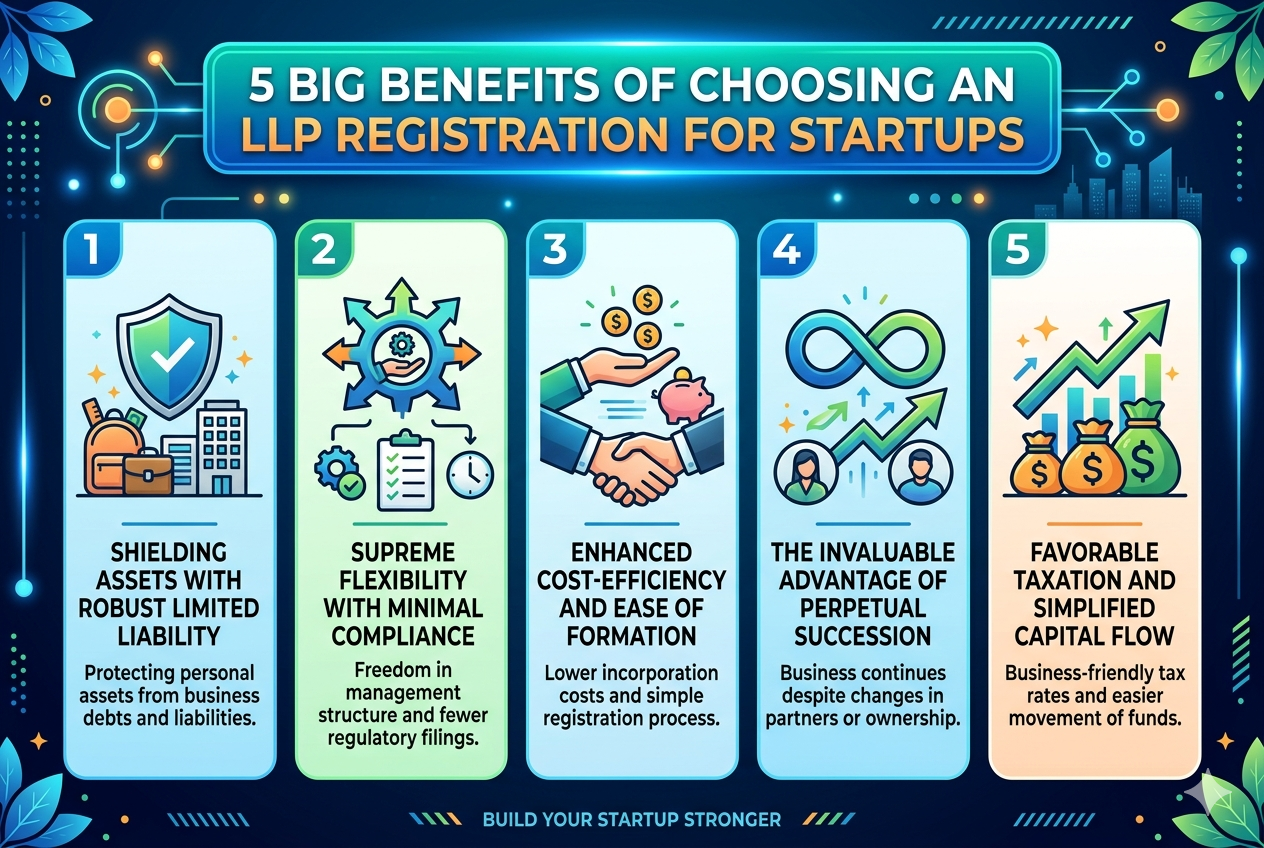
A Limited Liability Partnership bridges the gap between the structured corporate governance of a private limited company and the operational flexibility of a traditional partnership. It allows entrepreneurs to establish a co-owned business entity where individual owners are insulated from the collective liabilities of the firm. For startups trying to maximize every dollar of capital and every hour of productivity, choosing a Limited Liability Partnership Registration provides a robust legal shield without burying the business in paralyzing bureaucratic red tape. Below, we break down five monumental benefits that make an LLP the ultimate vehicle for startup success.
1. Shielding Assets with Robust Limited Liability
In a conventional partnership or a sole proprietorship, the business owners are inextricably tied to the financial fates of their enterprises. If the firm defaults on a loan or loses a catastrophic lawsuit, creditors possess the legal authority to pursue the personal bank accounts, vehicles, and real estate of the partners. This catastrophic scenario is completely averted through a Limited Liability Partnership Registration.
An LLP functions as a distinct legal entity, separate from the humans who manage it. Consequently, the financial liability of each partner is strictly capped at their agreed-upon capital contribution to the firm. Furthermore, partners are protected from the legal or financial fallout of another partner’s malpractice or negligence. If a co-founder makes an unauthorized, reckless decision, the personal assets of the remaining innocent partners remain safely out of harm’s way, giving entrepreneurs the confidence to take calculated business risks.
2. Supreme Flexibility with Minimal Compliance
Private limited companies are notoriously bound to rigorous statutory compliance requirements. They are frequently obligated to host formal board meetings, draft meticulous annual reports, appoint official company secretaries, and maintain extensive statutory registers. For an early-stage startup trying to discover its product-market fit, these administrative requirements represent a massive drain on time and financial resources.
Choosing an llp registration bypasses a massive portion of this regulatory fatigue. While LLPs are still required to file accurate annual returns and financial accounts to maintain transparency, their internal governance is incredibly fluid. The internal structure is governed entirely by the mutual LLP agreement signed by the partners. This allows founders to run their day-to-day operations with minimal interference, leaving more energy to focus on scaling the product, acquiring customers, and refining business models.
3. Enhanced Cost-Efficiency and Ease of Formation
Every dollar saved during the inception phase of a startup significantly extends its financial runway. When compared to incorporating a private limited company, the total expenditure involved in securing a Limited Liability Partnership Registration is remarkably lower. The legal fees, government registration tariffs, and documentation expenses are highly accessible for budget-conscious innovators.
The cost savings do not end with the initial setup. Because the ongoing maintenance and compliance duties are greatly simplified, the subsequent audit costs, legal maintenance fees, and administrative upkeep stay predictably low throughout the company’s lifecycle. Additionally, there is no arbitrary minimum capital requirement mandated to kickstart an LLP, meaning founders can officially register their entity with a modest sum and scale their capital as the venture expands.
4. The Invaluable Advantage of Perpetual Succession
A traditional partnership is inherently fragile; it can be automatically dissolved or thrown into legal chaos by the sudden retirement, insanity, insolvency, or death of a single partner. This systemic instability is incredibly unappealing to modern clients, suppliers, and prospective employees who desire long-term commercial relationships.
An llp registration solves this fragility by granting the business the superpower of perpetual succession. Because the LLP exists as a separate legal person, its continuity is entirely unaffected by shifts in ownership. Partners can seamlessly enter or exit the partnership through standard legal transfers without threatening the core survival of the business contract. This permanent nature reassures external vendors, institutional clients, and key talent that the business will endure through internal leadership transitions.
5. Favorable Taxation and Simplified Capital Flow
From a fiscal standpoint, an LLP offers an attractive mechanism for navigating corporate taxation and maximizing profits. Unlike traditional corporations that are frequently subjected to double taxation—where the company pays tax on its profits and the shareholders pay tax again on their dividends—the distribution of profits within an LLP can be structured quite efficiently depending on local jurisdictions. Furthermore, the absence of complicated dividend distribution taxes simplifies the mechanism through which founders can repatriate earnings back into their personal portfolios.
Moreover, the flexible capital structure inherent in a Limited Liability Partnership Registration permits partners to introduce or withdraw funds with far fewer legal restrictions than a corporation. This smooth capital mobility is highly advantageous for startups that experience volatile cash flow cycles and need to quickly adapt their financial positions without triggering complex regulatory audits or penalties.
Conclusion: Laying the Groundwork for Long-Term Growth
In the hyper-competitive modern business ecosystem, selecting a corporate structure requires a careful balance between legal protection and operational freedom. While large, venture-backed tech giants may occasionally favor a standard corporation for complex equity distributions, an immense volume of startups will find that an llp registration provides the ideal framework for sustainable early-stage growth.
By effectively shielding personal assets, cutting down on administrative compliance expenditures, ensuring perpetual corporate existence, and offering a highly economical setup process, the LLP enables founders to operate with maximum efficiency. Embracing a Limited Liability Partnership Registration ensures your business starts on solid legal ground, protecting your team today while giving you the freedom to build tomorrow.