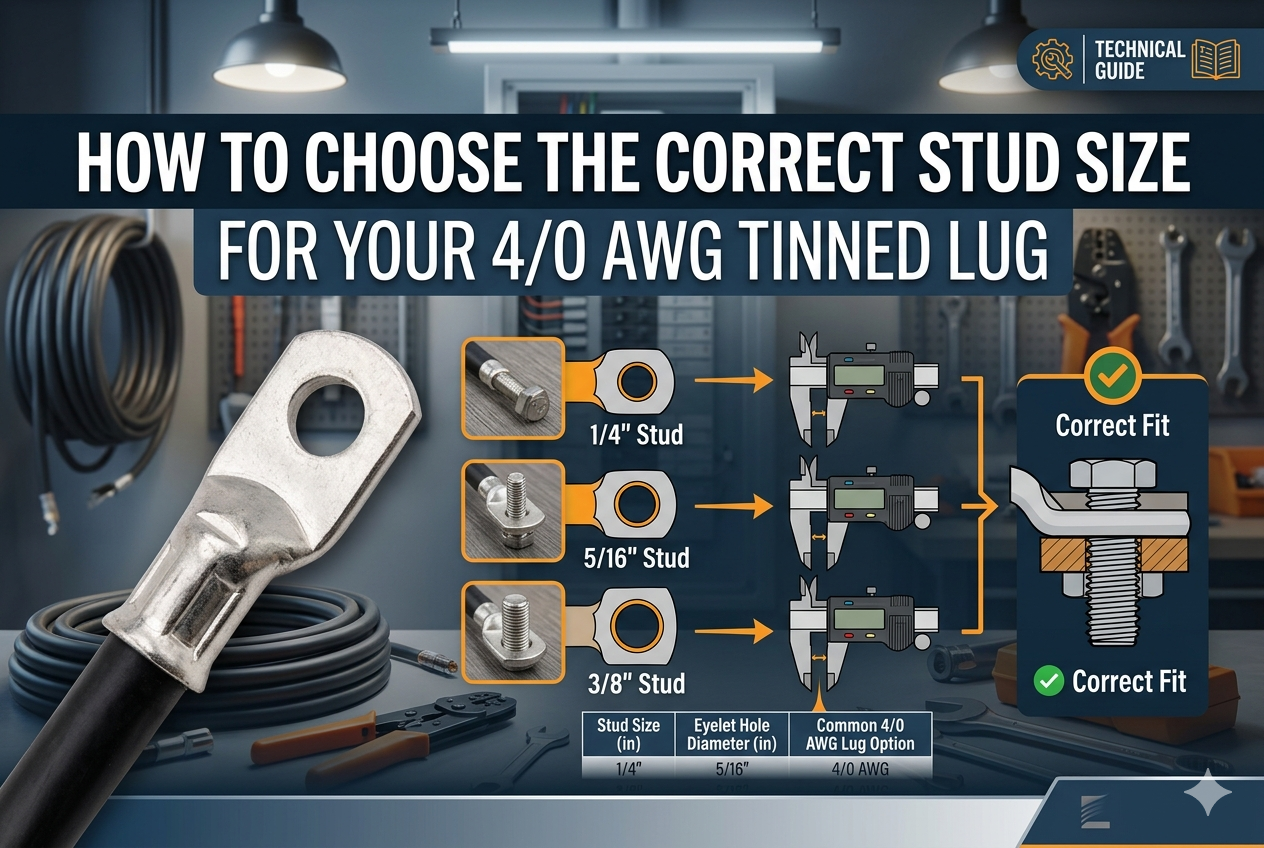
When dealing with heavy-duty electrical systems—whether you are wiring a marine vessel, setting up a commercial solar array, or installing a high-output backup generator—precision is everything. In these high-amperage environments, 4/0 AWG tinned lug connectors serve as the critical bridge between your heavy-gauge power cables and your equipment’s termination points.
While selecting the correct cable gauge ensures your wires won’t overheat, selecting the wrong stud size for your heavy-duty lug can completely compromise your electrical system. An improper fit leads to increased electrical resistance, dangerous heat buildup, and potential equipment failure.
Here is a comprehensive guide on how to accurately choose the correct stud size for your 4/0 awg tinned lug, ensuring a safe, efficient, and long-lasting connection.
Understanding the Anatomy of a 4/0 AWG Tinned Lug
Before diving into measurements, it helps to understand what a 4/0 AWG lug actually is. The “4/0” designation (pronounced “four-aught”) refers to the American Wire Gauge size of the cable the lug is designed to accept. A 4/0 cable is exceptionally thick, measuring approximately 0.46 inches (11.7 mm) in conductor diameter alone, and is rated to carry substantial electrical current—often up to 230 amps or more depending on the temperature rating.
The “tinned” aspect means the copper lug has been electroplated with a micro-layer of tin. Tinning protects the underlying copper from oxidation and corrosion, which is vital in humid, automotive, or marine environments.
A lug consists of two main parts:
- The Barrel: The hollow tube where the stripped 4/0 AWG cable is inserted and crimped or soldered.
- The Pad (or Tongue): The flat, extended portion featuring a hole designed to slip over a threaded stud, bolt, or terminal post.
While the barrel size is fixed to accommodate a 4/0 AWG wire, the hole in the pad comes in various sizes to match different standard electrical studs.
Why Match the Stud Size Precisely?
It can be tempting to buy a 4/0 awg tinned lug with a large hole (like $1/2$ inch) to ensure it fits “just about anything.” However, oversized holes create a critical point of failure.
Electrical current does not just flow through the bolt itself; it flows through the flat, mating surface where the lug pad presses against the terminal busbar or equipment face. If the hole in the lug is too large for the stud:
- Reduced Surface Contact: There is less metal-on-metal contact between the lug pad and the terminal.
- Increased Resistance: Less contact area forces the high amperage through a smaller “bottleneck,” creating electrical resistance.
- Thermal Runaway: Resistance generates heat. Under heavy loads, an ill-fitting lug can get hot enough to melt insulation, damage nearby components, or even ignite a fire.
Conversely, if the hole is too small, the lug simply won’t fit over the stud, halting your project entirely.
Step-by-Step: How to Determine Your Stud Size
Choosing the right stud size is a straightforward process of measuring and cross-referencing. Follow these steps to guarantee a perfect fit:
1. Identify the Destination Stud
Look at the component where the 4/0 awg tinned lug will be attached. This could be a lithium battery terminal, an inverter busbar, a winch solenoid, or a grounding block.
2. Measure the Stud Diameter
If the manufacturer’s documentation does not explicitly state the stud size, you will need to measure it yourself. The most accurate tool for this is a pair of digital or dial calipers.
- Open the calipers and close the jaws snugly around the outside threads of the stud.
- Note the measurement. If you are using a standard ruler, measure the absolute widest point across the top of the threaded post.
3. Match to Standard Hardware Sizes
Electrical studs are generally standardized into imperial (fractional/number) or metric sizes. Use the reference table below to match your physical measurement to the correct lug stud size designation.
| Actual Stud Diameter (Approx. Inches) | Actual Stud Diameter (Approx. mm) | Imperial Stud Size Designation | Metric Stud Size Designation |
|---|---|---|---|
| 0.190″ | 4.8 mm | #10 | M5 |
| 0.250″ | 6.4 mm | $1/4″$ | M6 |
| 0.312″ | 7.9 mm | $5/16″$ | M8 |
| 0.375″ | 9.5 mm | $3/8″$ | M10 |
| 0.500″ | 12.7 mm | $1/2″$ | M12 |
Pro Tip: For a 4/0 awg tinned lug, the most common industrial and marine stud sizes you will encounter are $5/16″$, $3/8″$, and $1/2″$. Smaller sizes like #10 or $1/4″$ are rarely paired with 4/0 wire because small studs cannot physically handle the mechanical torque or electrical load that a 4/0 cable demands.
Reading the Product Descriptions
When shopping for a 4 0 AWG tinned lug, manufacturers use a standardized naming convention. You will typically see products listed with the wire gauge first, followed by the stud hole size.
For example, a listing might read: “4/0 AWG Tinned Copper Lug, 3/8″ Stud.” This means the barrel is perfectly sized to be crimped onto a 4/0 AWG cable, and the hole in the flat pad is precisely drilled to clear a $3/8$-inch diameter bolt or stud with just enough tolerance to slide on smoothly without excessive wobble.
Best Practices for Installation
Once you have selected the correct 4/0 awg tinned lug and stud size combination, keep these installation rules in mind to ensure maximum safety:
- Use Proper Crimping Tools: A 4/0 wire is incredibly dense. Do not use a hammer or a standard hand-squeezer to crimp it. Use a heavy-duty hydraulic or mechanical compound crimping tool specified for 4/0 AWG terminals to achieve a cold-weld connection.
- Clean the Mating Surfaces: Even though your lug is tinned to prevent corrosion, ensure the busbar or terminal post it attaches to is clean, bright, and free of dirt or grease.
- Torque to Specification: Always torque the retaining nut to the equipment manufacturer’s recommended specifications. An undertorqued nut creates resistance; an overtorqued nut can strip the stud threads or crack the terminal block.
Conclusion
Selecting the right stud size for your 4/0 AWG tinned lug is a minor step that yields massive safety dividends. By taking a moment to measure your hardware and avoiding the temptation to use oversized “one-size-fits-all” lugs, you preserve maximum surface contact, minimize electrical resistance, and build a high-amperage power system that operates coolly and reliably for years to come.